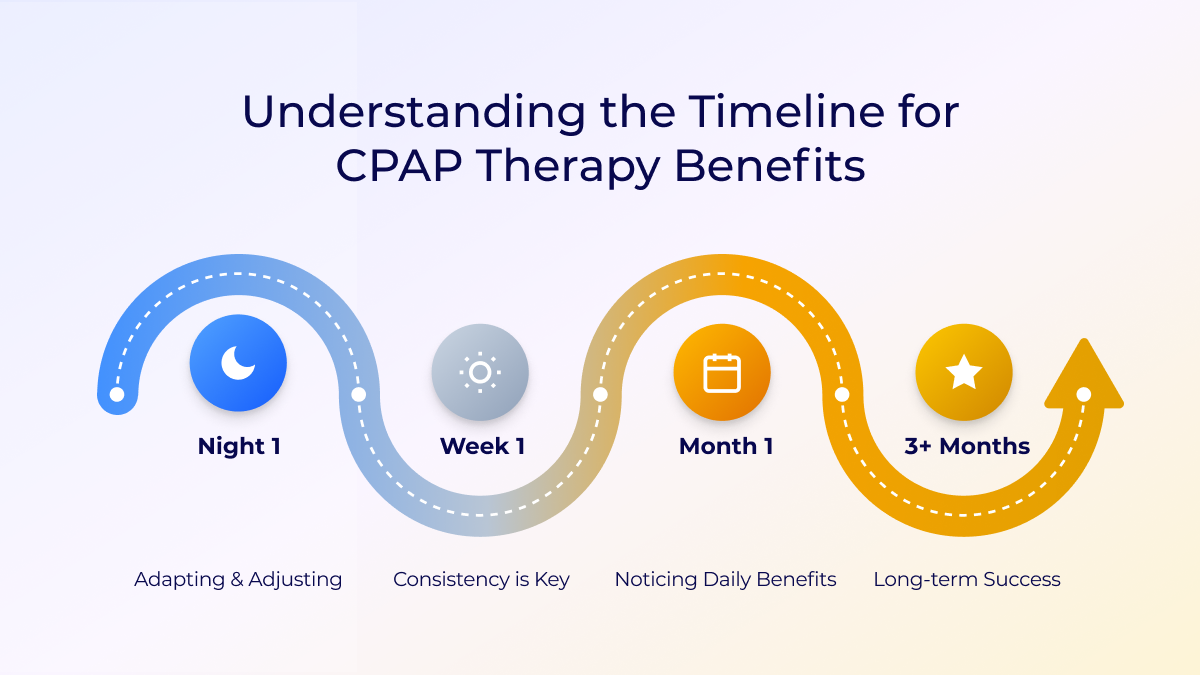
Understanding the Timeline for CPAP Therapy Benefits
After being diagnosed with obstructive sleep apnea (OSA) and starting Continuous Positive Airway Pressure (CPAP) therapy, one of the most common questions patients have, is: “How long will it take to feel better?”
While CPAP therapy can begin reducing breathing interruptions from the first night of use by preventing airway collapse, the subjective feeling of improvement is a gradual process that varies for everyone. Most users report noticing initial benefits within the first week, with more significant and stable improvements appearing over several weeks to months of consistent use [1].
The timeline for these benefits depends on several factors, including the severity of your sleep apnea, your overall health, and, most importantly, your adherence to the therapy. Research has consistently shown a clear dose-response relationship: the more hours you use your CPAP device each night, the greater and faster the improvements in daytime sleepiness, cognitive function, and overall well-being [2].
The Typical Timeline for CPAP Benefits
While every patient’s journey is unique, the benefits of CPAP therapy tend to appear in phases. This timeline provides a general overview of what you can expect.
Initial Phase: The First 1-7 Nights
From the very first night, the CPAP device mechanically prevents the breathing interruptions that define OSA. This could have an immediate impact on your sleep quality.
- Immediate Effect: The device is designed to reduce sleep apneas, hypopneas, and snoring by maintaining an open airway [3].
- Subjective Feeling: Some users, particularly those with severe OSA, may wake up feeling dramatically more refreshed after just one night [1]. For others, the initial focus is on adapting to the sensation of wearing the mask and breathing against the pressurized air. It is common to feel a small improvement in restfulness during this first week.
Short-Term Adaptation: Weeks 1-4
As you become more accustomed to the therapy, the cumulative effects of improved sleep begin to manifest more clearly in your daily life.
- Noticeable Improvements: During this period, most users report a significant reduction in daytime sleepiness and fatigue [4]. Morning headaches, if they were a symptom, often disappear [5].
- Cognitive & Mood Benefits: You may notice improvements in your mood, a reduction in irritability, and an enhanced ability to focus and concentrate. Research has shown that CPAP therapy can lead to measurable changes in brain structure associated with cognitive function [6].
Long-Term Benefits: 1-3 Months and Beyond
Consistent use over several months allows your body to recover from the chronic sleep debt accumulated over years of untreated OSA. This is when the most profound health benefits become apparent.
- Cardiovascular Health: Sustained CPAP therapy has been associated with improvements in blood pressure control in some patients [7]. Long-term observational studies have also linked consistent CPAP use with a reduced risk of serious cardiovascular events [8].
- Improved Daytime Alertness: After three or more months of consistent use, many patients report returning to optimal levels of daytime alertness and cognitive function [4, 6].
- Metabolic Health: For patients with co-existing conditions, consistent CPAP use may contribute to better blood sugar regulation and support overall metabolic health. Discuss any metabolic health concerns with your healthcare provider [1].
The Concept of Sleep Debt Recovery
Think of untreated sleep apnea as causing you to accumulate a significant “sleep debt” over months or years. Your body has been deprived of the deep, restorative sleep it needs to function correctly. When you begin CPAP therapy, you stop accumulating more debt, but you still have to “pay back” the existing debt [1].
This recovery process is why the timeline for feeling better varies so much. A person with severe OSA has a larger sleep debt to overcome than someone with a mild case. The recovery is a gradual process of allowing your body to finally get the consistent, uninterrupted, and properly oxygenated sleep it has been missing.
When You’re Not Feeling Better: Troubleshooting Your Therapy
If you have been using your CPAP device consistently for several weeks and are not noticing significant improvements in your symptoms, it is important to troubleshoot the issue rather than abandoning therapy. Here are common factors to investigate with your healthcare provider:
| Issue | Potential Cause & Solution |
| Mask Air Leaks | An ill-fitting mask can leak air, reducing the effectiveness of the therapy and causing noise or discomfort. Solution: Work with your provider to try different mask styles (nasal, nasal pillow, full face) and sizes to find a perfect seal [4]. |
| Incorrect Pressure Settings | Your prescribed pressure may be too low to be fully effective or so high that it causes discomfort and awakenings. Solution: Do not adjust the pressure yourself. Discuss your symptoms with your sleep specialist; they may recommend an adjustment or a switch to an auto-adjusting (APAP) machine [4]. |
| Insufficient Usage | Inconsistent use or using the device for only a few hours a night will limit the benefits. Solution: Aim for at least 4–6 hours of use per night, every night. Studies show a clear dose-response relationship, with greater benefits at higher usage [2, 4]. Use comfort features like the ramp function to help you fall asleep more easily [3]. |
| Mouth Breathing | If you use a nasal mask but breathe through your mouth, the pressurized air will escape, rendering the therapy ineffective. Solution: A chin strap can help keep your mouth closed, or you may need to switch to a full-face mask [4]. |
| Co-existing Sleep Disorders | Conditions like insomnia or Restless Legs Syndrome may also be impacting your sleep quality and require separate treatment [5]. Solution: Discuss all of your sleep-related symptoms with your doctor. |
Important Safety Information
Before starting any PAP therapy, it is crucial to discuss your full medical history with your physician. The Transcend Micro may be contraindicated in patients with certain conditions, including bullous lung disease, pathologically low blood pressure, pneumothorax, or a history of cerebral spinal fluid (CSF) leaks. For a complete list of contraindications, warnings, and potential adverse effects, please refer to the official Transcend Micro User Manual [3].
Frequently Asked Questions
How soon after starting CPAP will I feel better?
While the therapy works immediately to stop breathing events, most people begin to feel better within 1 to 4 weeks of consistent nightly use. The timeline can be faster for some and longer for others, depending on factors like the severity of your sleep apnea and your nightly adherence [1, 4].
Why am I still tired after using CPAP for a month?
If you are still tired after a month of consistent use, it is important to speak with your healthcare provider. Common reasons include a poorly fitting mask causing air leaks, incorrect pressure settings, or an underlying issue like mouth breathing or another sleep disorder that needs to be addressed [4, 5].
How many hours a night should I use my CPAP?
To achieve the best results, you should use your CPAP for all hours of sleep, including naps. Studies show a clear dose-response relationship, with greater benefits seen in patients who use their therapy for more hours per night. A common minimum target for clinical benefit is at least 4 hours per night [2, 4].
Disclaimer
The information provided in this article is for general informational and marketing purposes only. It is not intended to be a substitute for professional medical advice, diagnosis, or treatment. Please consult with your physician or another qualified healthcare provider if you have any questions about a medical condition or the use of a CPAP device. The Transcend Micro CPAP is a medical device that requires a prescription and should be used only as directed by a physician. For detailed information on indications for use, contraindications, warnings, and precautions, please refer to the official Transcend Micro User Manual [3].
References
- Sleep Foundation. (2023). Before and After CPAP: How Your Body Changes. https://www.sleepfoundation.org/cpap/before-and-after-cpap-machine-body-changes
- Kribbs, N. B., et al. (1993). Objective measurement of patterns of nasal CPAP use by patients with obstructive sleep apnea. American Review of Respiratory Disease, 147(4), 887–895.
- Transcend Inc. (2025). Transcend Micro User Manual (104149 Rev F). Available at: https://mytranscend.com/wp-content/uploads/2025/12/104149-Rev-F.pdf
- Weaver, T. E., et al. (2007). Relationship between hours of CPAP use and achieving normal levels of sleepiness and daily functioning. Sleep, 30(6), 711–719.
- Mayo Clinic. Sleep Apnea – Symptoms and Causes. https://www.mayoclinic.org/diseases-conditions/sleep-apnea/symptoms-causes/syc-20377631
- Canessa, N., et al. (2011). Effects of continuous positive airway pressure on brain structure in obstructive sleep apnea. Sleep, 34(6), 733–742.
- Patel, S. R., et al. (2014). The effect of CPAP on blood pressure in patients with obstructive sleep apnea: a systematic review and meta-analysis of randomized controlled trials. Thorax, 69(11), 1006–1013.
- Marin, J. M., et al. (2005). Long-term cardiovascular outcomes in men with obstructive sleep apnoea-hypopnoea with or without treatment with continuous positive airway pressure: an observational study. The Lancet, 365(9464), 1046–1053.